


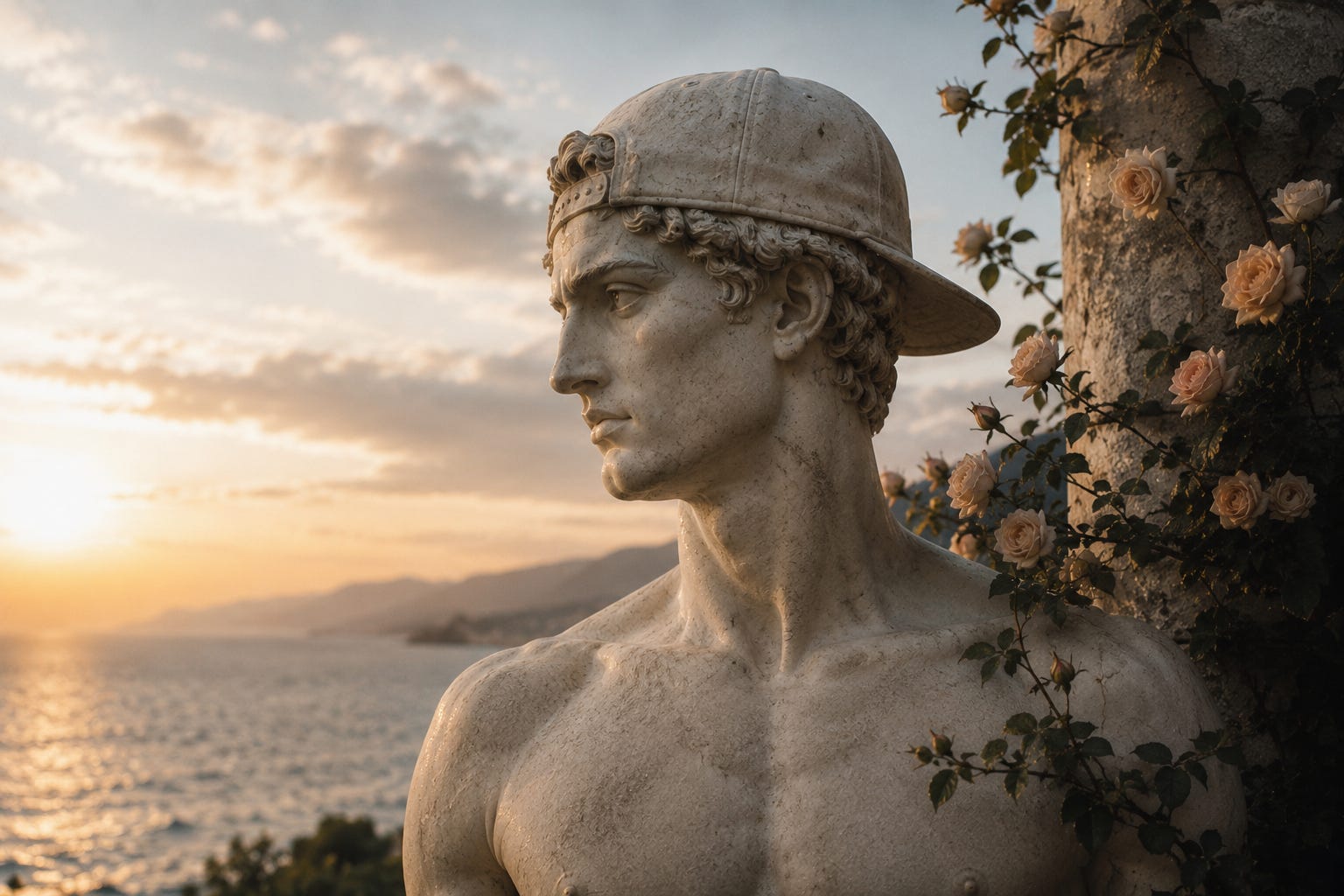
If the Ancient Greeks are to be believed, then the same sun that casts its light on us today is the same sun that spilled down on the heroes of old like Achilles, Hercules and other ‘eses’ of renown and taut muscular construction. The selfsame sun has begun its daily descent towards the western horizon and, consequently, bathes myself and all the other gymgoers on that side of Dumfries’s Bannatynes Health Club gym floor in that particular golden wash that recalls those heroic times of yore. It is under this particular quality of light that everything is universally enchanted and made closer to the divine, and with equal parts surprise and curiosity, I came to realise that this applies as much to the thing that has arguably slipped the furthest from its sacred calling in the fulness of time: the human male.
In the golden-hour haze, irradiated by bars of unassuming evening light, the men who complete their gruelling regimens are captured in motion, coated in the luminescence of those who resemble gods but who have entirely forgotten how to behave like one. Bounding lithely on treadmills, fastidiously extending themselves via the leg extension machine (hateful) or occupied with the exertion of the pectoral machine (even more so), they inhabit the world in a way which I find visually captivating but, moreover, spiritually barren. The Gym is the temple, its incense sweat and skin and lynx deodorant; its pantheon of gods resplendent in their ceremonial raiment of backwards caps, Nike socks, and five-inch inseam shorts.
In moments like this, where masculinity appears and exists under the spellbinding light of an ancient sun, I am transported to a moment of blissful security where the men surrounding me are temporarily afforded an element of divinity that should be synonymous with a code of behaviour and a moral occupation in the world that meets this physical divinity with equal rigour, and it is only when the sun dips behind a passing cloud and the spell is broken that I remember: so too is our masculinity.
In a world where masculinity, in its actual public application, has too often curdled into the brute worship of strength over delicacy, hardness over emotional elasticity, volume over moral completeness, it becomes the purview of the pagan worshipper* to make the case that masculinity itself is not the problem. Indeed, properly understood, it is a sacred calling. The tragedy is not that masculinity exists, but that it has become distended from its spiritual mission; stretched and twisted into a painful inversion of what it was meant to be.
In the age of the Manosphere, that airless little panic room of wounded vanity, monetised resentment, and men shouting about “discipline” when they really mean trauma conditioning, I continue to search for the masculinity carried through ancient storylines and older social codes. Not the man who dominates because he can, but the man who kneels, unembarrassed, to tie a child’s shoelace in the middle of a crowded room. The man who finds a beetle on the windowsill and carries it outside on one enormous finger, adjusting the whole machinery of his strength around the littleness of another life. The man whose voice could drown out a room, and does not; who understands that restraint is not self-erasure, but grace and skill.
This is the masculinity I was promised by myth, by chivalry, by every half-remembered god who used his strength in service of beauty, love, and the continuance of the world. And yet, look at what has been offered in its place: the sneer, the ranking system, the clenched jaw, the dead-eyed sermon on dominance delivered from the pulpit of an uninspiring and joyless office block. Reader, I fear I have been sold a false bill of goods.
In my dizzier moments amidst the daisies and Pimms (Brat Summer, eternal), I think often of the Knights of the old French romances; not as history, but as an aesthetic dream, a particular version of masculinity so beautiful it hasn’t entirely died. These Knights of my daydreams move through sun-soaked narratives in service of something positioned as both sacred and, crucially, feminine: the Duchess, the Lady, the court, the code of beauty and honour that holds the whole glittering premise together. There is no anxiety in their way of being; their whole existence is framed as duty-bound to honour meaning, devotion and a world made more lovely and liveable by gentility. For them, honour is not about their ego masquerading as honour, but rather about being committed to doing the honourable thing in service of others. These men occupy stone walls warmed by the sun, courtyards where wildflowers spring out from between flagstones, and meadows where bees hum lazy and fat, and they are not embarrassed to be a part of that gentle, colourful ecosystem because they know that existing within softness is not defeat, but rather the very soul of their victory.
There is a particular curiosity in me that seeks to imagine those selfsame knights transported into the visual culture of modern climes. They lean against the crumbling stone walls in shorts and tank-tops and baseball caps, they tread amid the flowers and foliage in Airforce 1s. The effect is intoxicating and exciting because I have taken the visual container of the modern man, which I have been spellbound by thanks to my sexual chemistry, and I have given him the grace of the timeless masculinity which came before he was corrupted by podcasts and church sermons and Mark Wahlberg.
It is in the wake of this meditation on the disconnect between body and the spiritual inhabiting of that body that I begin to reflect on how the sacred masculine is not above the body, but rather revealed through the sacred duty of fully mastering it, specifically, through the discipline of not using it to its fullest extent. The sacred masculine is to be found in the physical presentation of a man in the way that we have come to understand him, but only so far as that man inhabits that body with the restraint, gentility, and delicacy required, for example, to pick up an insect without hurting it. The measure of a man is not in the force with which he presses his booted sole into the earth, but rather in the litheness and skill he exercises in order to cross the meadow without crushing the poppies underfoot.
The old gods were never shy about embodiment. Apollo did not descend from Olympus with a protein shake and a portfolio of cryptocurrency. Dionysus was crowned in ivy and anointed in wine; Hercules sweated under a Grecian sun; Achilles sulked with Himbo petulance; Adonis lay golden and half-undressed beneath fig trees while entire cosmologies reorganised themselves around the fact of his beauty. The sacred masculine, in its original and uncorrupted form, was never antiseptic. It was salted and sun-bleached and crowned in laurel and flowers.
And so I continue, with all the devotional seriousness of a Vestal Virgin who has accidentally wandered into a JD Sports, to contemplate the modern athletic male with something perilously close to religious awe. Not because I believe men are gods automatically. Quite the opposite. Most are spiritually underachieving quite dramatically. But every now and then, under the correct atmospheric conditions (heat, sunlight, exertion, laughter, perhaps a little sea salt carried inland on the wind), the ancient divinity flickers visibly through the modern costume.
A young man in white Nike socks and a backwards cap leans against a stone wall eating a peach in the August heat and suddenly the entire Mediterranean Classical world returns to me in one violent rush like a hit of poppers. Marble courtyards. Olive oil. Bronze skin. Lads wrestling in palestrae beneath painted ceilings. The smell of rosemary crushed underfoot. Libations poured into dry earth. Hymns to gods who understood perfectly well that beauty was not frivolous, but sacred infrastructure.
What entrances me is not vulgar dominance or the dreary modern performance of “alpha” masculinity, which strikes me as spiritually equivalent to fluorescent lighting: harsh, joyless, and humiliating to endure for prolonged periods. What instead entrances me is something much older and more ceremonially alive: the sight of masculinity inhabiting itself beautifully. Not carelessly trampling the world beneath it, but moving through it with the unconscious physical confidence of a large and powerful animal that has nevertheless learned gentleness. The broad hand lifting the beetle from the windowsill. The forearm flexing as a child is scooped effortlessly onto a hip. The sweat-dampened boy in running shorts pausing mid-conversation to move a snail from a pavement before somebody steps on it. The rugby player, all thighs and impossible calves, lying back laughing among wildflowers without feeling that softness diminishes him.
This, to me, is where the sacred masculine reveals itself most completely: not in conquest, but in stewardship of beauty. And in devotion to it.
The old pagan world understood this instinctively. Consider Ares, hot-blooded and bronzed, forever drawn back toward Aphrodite despite the mockery of the other gods; the war god himself unable to resist softness, perfume, golden skin, the unbearable gravitational field of beauty. He is not diminished by this longing. He is humanised by it. Completed by it. Even violence kneels eventually at the altar of love.
Or Dionysus, winding ivy through his dark hair as he moves laughing among women crowned in flowers, dissolving the rigid architecture of ordinary masculinity in wine, theatre, dance, fruit split open beneath the sun. Dionysus does not fear femininity contaminating him. He understands that ecstasy requires surrender. That the masculine becomes more radiant, not less, when it allows itself to be intoxicated by softness, beauty, and devotion.
And perhaps nowhere is this sacred impulse rendered more beautifully than in the tragedy of Apollo and Hyacinthus. Apollo, golden, radiant, god of music and prophecy and sunlight, does not merely desire Hyacinthus. He delights in him. The myths linger not on conquest but companionship: the two of them running together through Spartan fields, stripped by the heat, laughing, wrestling, throwing the discus beneath the hard white blaze of the Mediterranean sun. And when Hyacinthus dies, struck down in one terrible accident, his beautiful body collapsing into the grass, Apollo does not retreat into stoicism. He mourns extravagantly. Publicly. Devotionally. He kneels in the dirt beside the boy he loved and transforms spilled blood into flowers so that beauty might continue carrying his memory forward into the world.
This is what the ancients understood that the modern masculine has catastrophically forgotten: that strength reaches its highest expression not in domination, but in adoration. The sacred masculine does not become less masculine when it kneels before beauty. It becomes divine.
And this instinct is not exclusively heterosexual, despite the best efforts of spiritually malcontent internet entrepreneurs to flatten masculinity into a joyless heterosexual panic. The old world understood perfectly well that masculine devotion could flow toward other men without compromising virility in the slightest. Achilles grieving Patroclus. Apollo crowned in grief for Hyacinthus. The physically powerful man arranging his strength around something softer and beloved, not because he has been conquered by it, but because he delights in serving it.
That, if I am being perfectly honest, is the thing that truly undoes me. Not dominance. Not cruelty. Not the sterile little theatre of humiliation mistaken for masculinity by men who have never once in their lives encountered genuine reverence. What entrances me is the sight of masculine strength joyfully orientating itself toward devotion. The broad-shouldered rugby player stooping instinctively to brush hair from another man’s face after too much wine. The powerful hand resting gently at the small of the back in a crowded room. The physically confident man delighting in caring for something softer than himself.
Which is why the modern manosphere feels so catastrophically godless to me. Not secular, godless, an entirely different condition. A spiritual landscape in which masculinity has become severed from sensuality, beauty, softness, poetry, devotion, and ecstatic communion with the living world. They speak endlessly of discipline because they have forgotten worship. They speak endlessly of domination because they have forgotten reverence. They speak endlessly of becoming “high value men” while radiating all the erotic and spiritual vitality of an unseasoned chicken breast on wilted chlorine-washed lettuce.
And meanwhile the gods continue appearing absolutely everywhere else. At Bannatynes in Dumfries beneath the blonde light of early evening. Outside pubs with their arms slung around each other’s shoulders. On harbour walls slick with saltwater. In sunburnt courtyards. In gardens full of bees. In half-buttoned linen shirts. In Air Force 1s powdered faintly with dust from the road. In boys who have no idea they are briefly, accidentally carrying Apollo in the line of their shoulders.
This is why I cannot quite surrender to cynicism regarding masculinity, despite the best efforts of podcasters and finance bros and men who treat emotional repression as though it were an Olympic discipline.
Because I have seen the gods.
Not metaphorically.
I have seen them glistening with sweat in five-inch inseams beneath the descending gold of a Scottish sun, laughing with their whole chests open, beautiful and mortal and entirely unaware of the divinity pressing through them like wine through crushed fruit.
And I maintain, with all the irrational certainty of the devoted pagan, that the world becomes softer, safer, and more beautiful whenever such men remember what they are for.
Masculinity without tenderness is a magnificent house with all the fires unlit. Structurally impressive but deeply cold and unliveable. The architecture of it will hold, but no one is comfortable, and the owner cannot understand why visitors do not stay.