


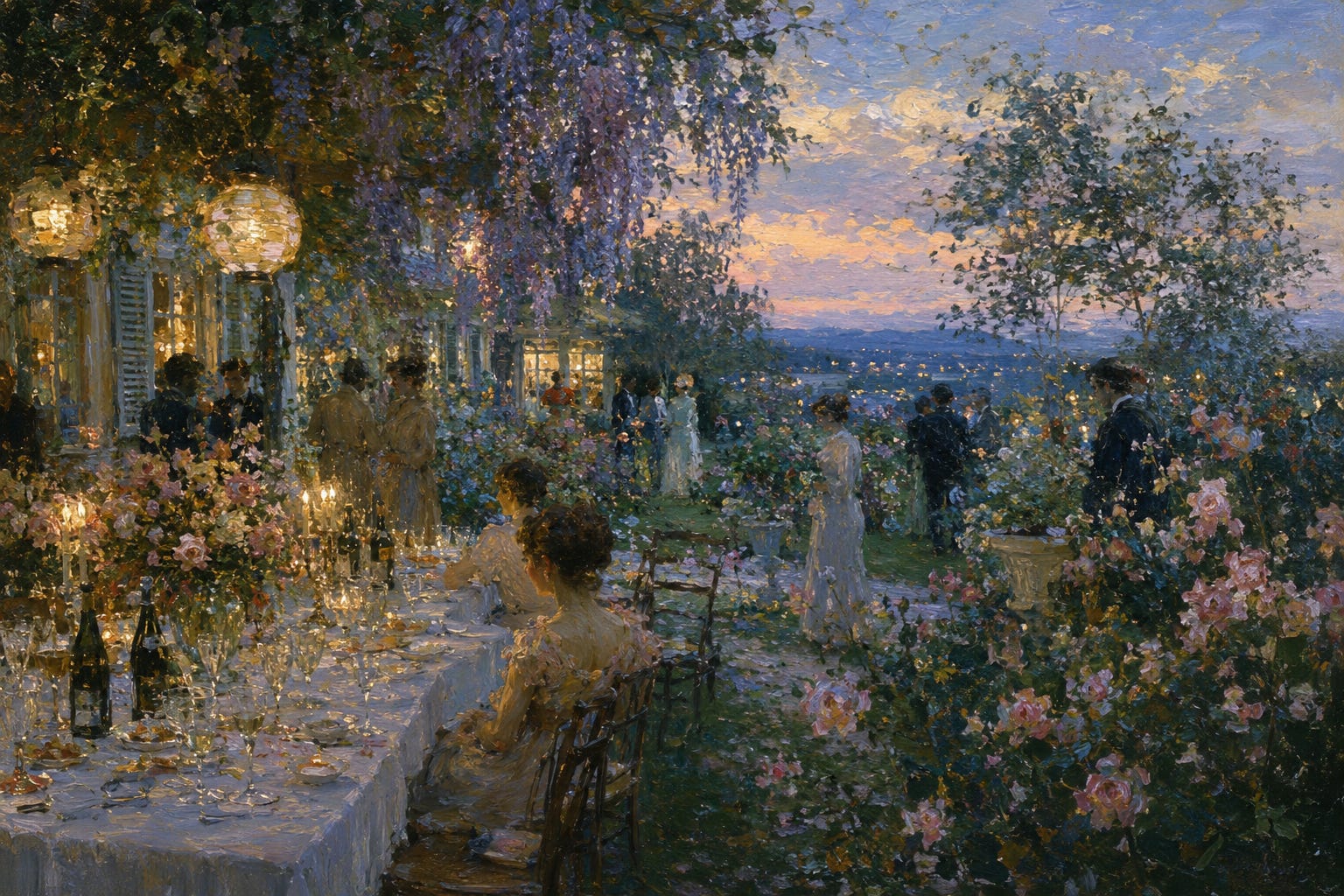
In this most hallowed week in the month of May, where gardeners and people with limited social motility get deeply enthused about the Chelsea Flower Show, I felt it might be appropriate to write a reflection on the deep importance of gardens and green spaces as the theatre for essential and functional exchanges of ideas.
By the end of this piece, I intend to have made a coherent argument that the garden party, properly conceived, and historically grounded, is one of the better solutions available to the particular social poverty of modern life. I am aware this is a large claim to hang on a concept most strongly associated with cucumber sandwiches and the minor anxieties of the English middle classes. I am making it anyway.
Lately I have been thinking about the garden party. Not the brutalistic modern iteration with prosecco-in-a-paper-cup tawdriness and a jumble of (invariably wet) plastic lawn chairs which one attends out of love for the host and departs slightly damp about the rump (and the spirit); but the garden party as institution, as a vessel for the gathering of interesting people with the particular social freedom that comes from conducting one’s conversations outdoors, where the sky permits a looseness on proceedings that no interior space, however well-dressed, can replicate.
The great historical practitioners of the outdoor salon understood this intuitively. Consider the Empress Joséphine, who transformed the somewhat unpromising grounds of Château de Malmaison into what she declared she would make “the most beautiful and curious garden in Europe.” Joséphine’s project at Malmaison was not merely horticultural. When Napoleon and Joséphine married, everyone in Napoleon’s circle from sea captains to ambassadors was encouraged to send or bring botanical specimens to Malmaison. The garden functioned as a kind of soft-power machine: a space where influence was cultivated as carefully as the dahlias (which Joséphine introduced to France) and the 250-odd varieties of rose. The great glasshouse on the grounds was constructed not only to protect her collection of exotic plants, but also to serve as a space for entertaining guests. After her divorce from Napoleon, Joséphine simplified court etiquette but continued to receive artists and the intellectual personalities of her time in those grounds until her death. The garden was, for Joséphine, the primary site of her social life and her legacy both.
A century later, Lady Ottoline Morrell achieved something similar, though rather more bohemian and considerably more sexually complicated. At Garsington Manor in Oxfordshire, the celebrated hostess turned her Jacobean country house into a combined literary salon, pacifist’s refuge, and near-perpetual party for left-leaning members of the British intelligentsia. She saw the home and its garden as a “theatre for social gatherings”, inviting visitors to respond to the space she had created with poetry and artwork. W.B. Yeats came. Virginia Woolf came (and then wrote Ottoline biting letters about the other guests, which is so her). Aldous Huxley came and promptly satirised her in a novel (which is so him). D.H. Lawrence came and also satirised her in a novel (simply the Lawrence tax, levied on all who showed him kindness). None of this deterred Ottoline, who grasped that the garden party, even at its most raucous, ungrateful, and overpopulated with future Nobel laureates who were shagging one another, was worth it. The reputation and influence of the salonnière extended well beyond her immediate social circle, allowing her to act as a cultural power broker and patron. The garden was the mechanism and the metaphor both, the place where ideas cross-pollinated with the same promiscuous enthusiasm as the roses.
I have my own, admittedly less historically significant, data point. My 18th birthday celebration was a garden party that took place in the gardens at our home in rural New South Wales. Complete with a string quartet and a table which had to be custom made to support the jarrah wood cheeseboard (also custom made for the occasion), the day passed in a beautiful haze of chiffon and hibiscus flower champagne cocktails before spilling into a messy, lawless barbecue under cover of night. I have particularly fond memories of the moment where one of the guests had to leave to attend a family dinner in celebration of her grandfather being successfully elected Mayor just that afternoon, but was delivered promptly back to the party at dusk by an enormous combine harvester tractor.
This is what I mean when I speak of the garden party as irreplaceable social technology. The combine harvester is not a feature of, for example, the dinner party. The dinner party, for all its pleasures, is a contained thing: it begins, it proceeds through courses, it ends, and everyone goes home at a mutually agreed time without ever having stood under an open sky trying to remember whether they had a fifth champagne cocktail or a sixth.
The garden party is a fluid thing. It accommodates, within a single afternoon, the string quartet and the barbecue, the formal and the lawless, and encourages the dissipation of guests in cliques into the foliage and shrubbery. It is, structurally, an argument for the fullest extent of human interaction.
And we need it. More than we may think, and somewhat urgently. Because here is what modern social life in your thirties actually looks like, rendered honestly: it is a group chat in which six people have been trying to find a date that works for everyone since September. It is a series of individually lovely one-to-one coffees that somehow never coalesce into an actual social happening. It is a dinner party for eight where you sit next to the same person for three hours and conduct the same conversation you conduct every time, which is fine, you love them, but which involves no surprises and no cross-pollination and absolutely nobody arriving on a combine harvester. It is, increasingly, the reconstituting of an endless string of the same copy-pasted night in the pub into various iterations of Instagrammable paraphernalia.
This is not melodrama, the data is unambiguous. Time spent with friends in person has dropped by twenty hours per month since 2003, and in America, the Surgeon General has declared a loneliness epidemic. A third of adults report feelings of isolation, a figure that has barely shifted since the pandemic made it briefly fashionable to discuss. We have become rich in connectivity and poor in connection, and the gap between those two things is the crucible in which misery and ennui meld into that most hateful alloy: resignation.
The research on what actually challenges this is now substantial enough to constitute an argument. Reviews of the relationship between nature and health identify social cohesion and increased social contact as a major pathway through which the natural environment supports better health. Green spaces promote social interactions, fostering community and measurably reducing lon eliness. Studies have found that exposure to natural environments lowers cortisol, reduces aggression, and, curiously, improves feelings of neighbourhood safety. In short, the outdoors makes people kinder and more trusting. This seems like a useful quality in a gathering space.
What the dinner party fails to do, and the group chat absolutely cannot do, is create the conditions for serendipitous connection. The encounter that wasn’t planned. The conversation that begins because two people are both standing near the wisteria looking for a moment away from that one mansplainer. The unexpected ideological alliance formed over a shared opinion about the roquefort placed on the cheese board. The social infrastructure of the garden party is to be found precisely in its lack of infrastructure; a loose enough container that people can find each other in it, rather than being assigned to each other in advance by a purse-lipped and brow-beaten hostess.
The question of how, practically, to achieve this in current climes is a fair one, because I am not unaware that most of us do not have a Malmaison or a Garsington, and following my family’s decanting from the Sydney house into substantially less than our customary five acres of garden, I too feel this keenly. But I would argue the spirit is more important than the acreage.
The mechanics of a genuinely good garden party, I posit, are not complicated. What is required is: an outdoor space of any size, real glasses (non-negotiable; the paper cup is the enemy of the occasion), something beautiful to look at (even if that something is a single pot of begonias positioned with whimsical abandon), food that does not require anyone to sit down at a designated place, and, crucially, an invitation list constructed with the explicit goal of introducing people who do not already know each other. This last element is the one most consistently missing from modern social life and most consistently present in every account of the great salons. Joséphine’s genius was not in her gardenias; it was in her guest list. Ottoline’s legacy was not her Italianate garden but the conversations she engineered within its walls. Invite the people your existing friends don’t know. Put them outside. Provide champagne in real glasses. Let them ambulate in the free-spirited manner of the countryside.
Chelsea Flower Show, for all its grandeur and its extraordinary garden installations that nobody will ever actually reproduce at home, is at heart a love letter to this idea: that green things, tended with care, arranged with intention, and shared with other people, are one of the primary joys available to us. The show’s enduring appeal is surely less about competitive horticulture and more about the collective fantasy it represents, the garden as a place where life is beautiful, chaotic, and conducive to excellent conversation.
Joséphine knew it. Ottoline knew it. The combine harvester, arriving back at dusk with its passenger in her cocktail dress, knew it too, in whatever way combine harvesters know things.
It is, therefore, high time we revived the garden party; and I await a litany of invitations over the upcoming summer season.