


Anyone familiar with my personal mythology will know that I spent a large portion of 2016 substantiating my education of all kinds in the Swedish province of Östergötland. Somewhere in between the storylines that saw me swept into a doomed love affair with a dashing military pilot and that saw me appear in two different versions of fairytales adapted in contemporary performance in a state of undress, I was actually intimately absorbed in and enchanted by my studies in the Linköping University module on Nordic Culture, 754G52 for those who like their existential musings academically credentialled.
The module captured me so because it was distinctly and unapologetically experiential, veering deliciously and unexpectedly away from the stuffy academia of the Scottish persuasion and living wholly in the dimension of uncited feeling over peer-reviewed fact. Our experience of this module came not from screeds of text and data, but from going out into the world and experiencing the subject matter, the culture, as lived phenomena.
The underpinning principle of the module was that the relationship between a Nordic person and their landscape is not incidental to who they are, but constitutive of it. Friluftsliv, or free air life, as a form of cultural grammar, a language of the self understood through birch forest walking and yarn spinning and storytelling under the night sky. As a person who has struggled to find real meaning and connection to their own cultural heritage without it being demanded of me by at least one smirking pseudo-historian to ‘qualify’ with fact exactly why I feel that connection, I was carried off by the ease with which the Scandinavians accepted their place in an unbroken lineage spanning centuries.
What struck me hardest that year (excluding the realisation that I was, to no one’s real surprise, a homosexual) was the effortlessness of the continuity of Nordic culture from Viking-age settlement through to flat-pack furniture, forest schools, herring-jars, and Avicii. The module covered folk-art, music, dance, immaterial culture, popular belief, folkloristic tales and sagas, festivals, cooking. And none of it was framed as heritage in the fusty, roped-off, do-not-touch-the-artefact sense that I had grown up understanding the word. It was just culture as living, ordinary, breathable like air. The traditions we examined weren’t specimens in formaldehyde, but the water everyone was already swimming in, largely unaware they were swimming at all, because that is precisely what a healthy relationship to your cultural inheritance looks like: you don’t notice it, any more than a fish notices the sea.
I thought about home all the time I was in the business of this study. Not Scotland, exactly; certainly not Scotland in the abstract, all misty glens and shortbread tin verbosity. I thought about the Solway coast and the river Nith, of the golden light of a Galloway autumn in Mabie Forest. I thought about the people I had grown up to take a place among and never quite been given the permission to embody. I thought, without entirely realising it, about the Gall Gael experience.
Before we go any further, I want to talk about Lady Devorgilla. Devorgilla of Galloway, or Dearbhfhorghaill, if you want to invoke her regal Gaelic fullness, was born around 1210 and died in 1290, and in the intervening eighty years conducted herself with a political acuity and a personal grandeur that makes the standard Scottish cultural script of dour, subsistence-level Scots-persons-barely-surviving-the-climate-and-devoid-of-any-intellectualism feel not merely inadequate but actively offensive.
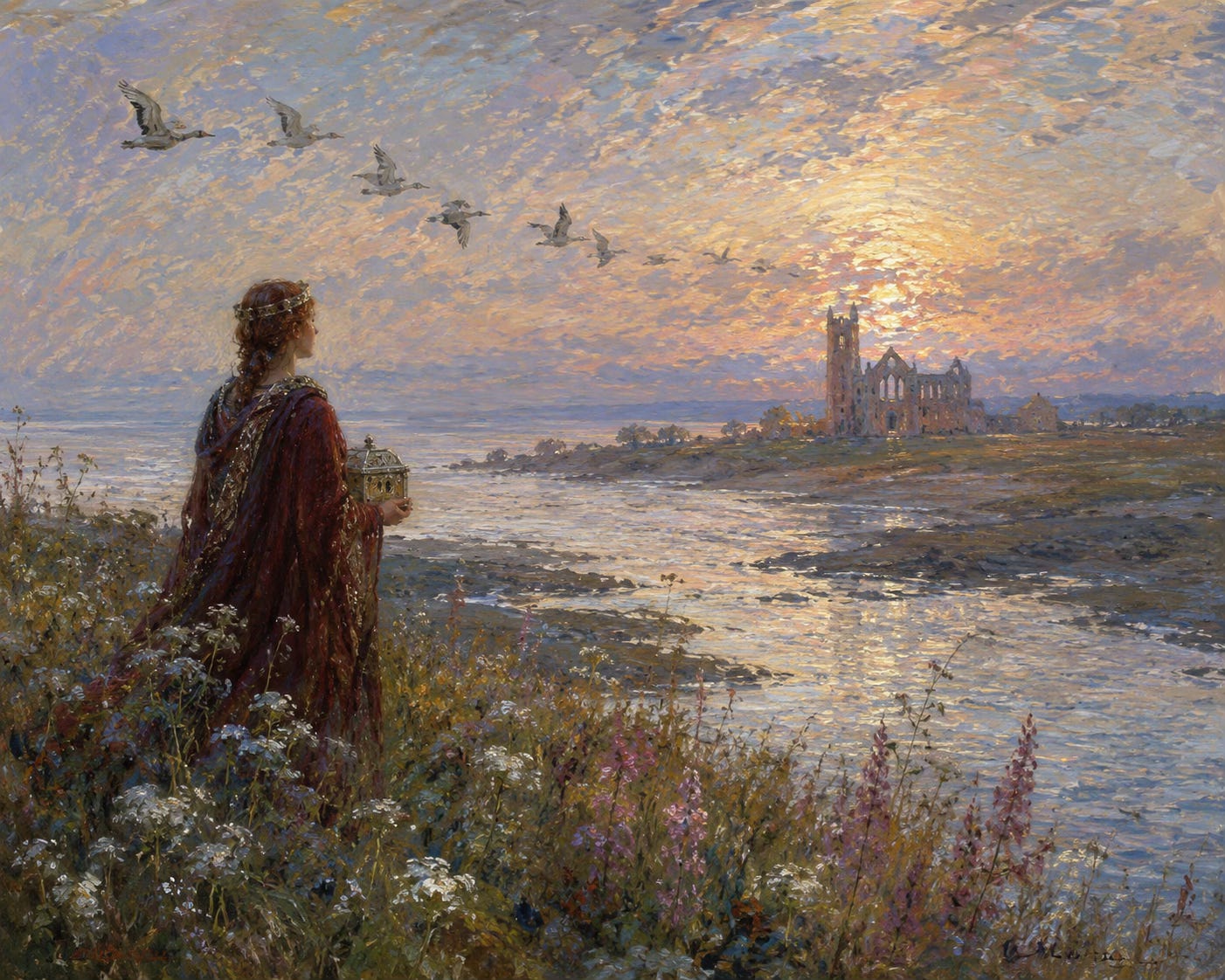
She was, by any reasonable measure, one of the most powerful people in thirteenth-century Britain. Heiress to the vast Lordship of Galloway, a semi-independent Norse-Gaelic kingdom that had spent centuries resisting absorption into Scotland with a vigour that I register as inspiring, she married John de Balliol and together they became some of the greatest landowners in Europe with estates from the Scottish Highlands across northern England into France. She co-founded Balliol College, Oxford, not as honorary patron, not as gracious benefactress, but as operational co-founder, writing its first formal statutes in 1282, a foundational framework so robust that parts of it remain in use today. The college coat of arms displays the rampant lion of Galloway; her lion. She also built Sweetheart Abbey, a Cistercian foundation of considerable architectural ambition in red Galloway sandstone, which she conceived and erected in memory of her dead husband, whose embalmed heart she carried around with her in an ivory casket bound with silver for twenty-two years.
I want to pause here, because I think the heart deserves a moment. A woman of tremendous power and considerable sophistication, grieving publicly and extravagantly and without any apparent embarrassment whatsoever, carrying her husband’s embalmed heart across Europe in a jewelled box, founding institutions of learning and abbeys of stone as regular appointments in her busy diary. This is not a brutish woman of the hills with nary a tooth betwixt her gums. This is not the crude, crass, laughable figure that the Scottish cultural cringe has primed us to encounter when we reach into our regional past. This is someone with ethereal grit. Someone who wore her emotion as a political statement, and who left behind an impressive legacy portfolio consisting of colleges, bridges, churches and politically wayward children. She was Gall Gael, but we have almost entirely forgotten what that means.
Gall Gàidheal, or foreign Gaels, stranger Gaels, is the name given to the Norse-Gaelic people who emerged from the Viking Age as something hot off the 9th Century press: neither Norse nor Gael but the extraordinary, sea-salted remix of both cultures. When the Vikings came to the coasts of Ireland and western Scotland from the ninth century, they did not simply raid and leave. They stayed, they intermarried, and became, with the pragmatic fluidity that still characterises the best of the Nordic temperament, Gaelicised. And the Gaels, in turn, absorbed the Norse seafaring ambition, the Scandic love of story and saga, and the Norse organisational efficiency and genius for establishing lasting systems in spite of turbulent political climes and difficult coastlines (the latter we have sadly seemed to abandon in our corner of the South in more recent epoch).
The result was the Gall Gael: a people who shaped the Irish Sea region from the ninth to the twelfth centuries, who founded the Lordship of Galloway and shaped the Kingdom of the Isles, Dublin, Man, the Hebrides and the maritime routes between them. The Galloway Hoard, discovered in 2014, says it in tangible treasure: over a hundred items including silver arm-rings, brooches, and a gold ingot, combining Norse and Celtic design in a mixed visual language. Neither one thing nor the other (and lots in-between).
The word Galloway grew out of this peculiar soil, the “Gall” having its origin firmly in Gall-Gael. We live inside the etymology. We walk with their name every day and mostly don’t notice, which is either poetic or tragic depending on what wine you’re drinking when you consider it. We are not from a footnote culture, nor a minor regional variation on a more important story happening elsewhere. The Gall Gael were a seafaring people, a land-managing people, a people who moved between the fjords of the north and the Celtic mysteries of the west with the ease of those for whom the sea is not a barrier but a super-highway. We were lithe and sharp and mythic, our art was intricate, our political structures were sophisticated. Gall-Gael women, like Devorgilla, were serious operators, educated, wealthy, influential, possessed of an interior life rich enough to produce both a college of learning and twenty-two years of political influence.
And yet, in the fullness of time, we found ourselves ultimately absorbed by the idea of Scotland and then, succumbing to the fate of our captors, our proud spine bent double as we were compressed, with the rest of our host nation, into a compact shortbread tin in garish tartan, cut in the shape of a hulking ginger-haired loon emblazoned with a whip-crack “och aye the noo” in uninspiring lettering. The reduction of an ancient, complex culture crusted with salt and mythos reduced to a supporting part in a cheap novelty act. This is what happens when the cultural thread connecting a modern people to their ancestral way of inhabiting the land is severed.
I have been somewhat coy about what exactly I took from module 754G52 at Linköping and should like now to be direct. The module covered culture and cultural heritage, identity creation, folk art and craft, folk music and dance, immaterial culture (popular belief, fairy tales, folkloristic sagas), as well as traditions, festivals, and cooking. It was delivered hugely through outdoor education, residential components, field trips, excursions into both urban and rural landscape. The Swedes’ relationship to their natural world was studied not as an environmental topic but as a cultural one: the central fact of identity, from which all the other facts radiate. You cooked the food to be eaten from your kayak in the middle of a magnificent lake, and walked the forest tracks and listened to the stories under the night sky in the very landscape that produced them. And, none of this was considered “wishy-washy namby-pamby nonsense” in the way it almost certainly would be by much of the hand-wringing, slack jawed miscreants of the modern-day Scotland who sit with their ire on the sidelines and throw acidic jibes at anyone who has the temerity to try and reconvene a sense of unity between person and place outside of a council-sponsored vegetable allotment.
The learning outcome I remember most clearly was not strictly on the syllabus, but it was implicit: the Nordics do not have to justify their culture. They do not have to qualify it, footnote it, apologise for its more enthusiastic expressions, or submit it to the tribunal of an armchair historian whenever they want to embrace it. They carry it in their bodies. A Swedish person eating herring is not performing Swedishness. A Norwegian person ski-touring after work is not making a political statement. A Finnish person going to the sauna is not sagging under the forced labour of heritage preservation. They are just doing the thing, as their people have always done the thing, in the landscape where the thing was always done. The thread is unbroken. The fish swim, unaware.
This is what I see as a Gall Gael problem, not just a Scottish one. Because if Scotland’s cultural inheritance has been flattened into the highland shortbread tartan tin, then Galloway’s has been further obscured inside that already-inadequate frame. We don’t even get the romanticised and commodified version of our culture, we get the footnote, the regional variation. The bit that isn’t properly Highland and therefore doesn’t quite qualify for the misty glen Outlander treatment, but isn’t considered economically viable enough in the context of national tourism marketing to qualify under any other category for specific nuanced representation.
What we actually are, if we go back to history, landscape, the actual etymology of the very ground we stand on, is something far more interesting than either the Highland romance or its absence. We are the intersection of the Viking north and the Celtic west. We are a seafaring people turned land people, our harbours still carrying Norse echoes, our farmland still remembering the shieling patterns of the Gall-Ghàidheil, our Gaelic, now extinct, Galwegian Gaelic the last to go, surviving by some accounts into the eighteenth century, having once shaped the sound of the prayers spoken in the thousands of chapels that pepper our curious coastline.
And here is where I depart from the academic mode, because the Nordic module taught me, among other things, that this departure is not only permitted but necessary. The Nordics do not wait for an archaeologist to sign off before they feel at home in their culture. The friluftsliv practitioner does not cite a paper before walking into the forest. The skald does not submit the folk song for peer review before singing it. The relationship to heritage is lived, and it is lived in the body, and it is communicated not through information but through the continuous practice of being a person in a particular place in a particular way.
So, let me now arrive at the crux of my argument in my longship bedecked in Celtic linework with a pride flag stapled haphazardly to the mast. I believe I come from a lithe and seafaring people for whom the Solway was not a border but a thoroughfare, and who were never quite domesticated by the political structures that tried to absorb them, the Lords of Galloway (my literal ancestors according to the meticulous genealogical endeavours of my late great-grandmother) resisting Scottish royal authority with a persistence that the chronicles found querulous and I find magnificent. A lineage of women who carried their power with a matter-of-factness that Devorgilla exemplifies and that no tartan tea-towel has ever captured.
I believe I come from a people who knew their herbs. Who understood the Solway tides as calendar. Who tracked the deer through Galloway forests and who named the hills and the burns and the headlands in a language that was simultaneously Celtic and Norse, theirs in a way that no forced state-cultural-identity can replicate. I believe that the elderwort and the meadowsweet growing on the banks of the Nith are grammar in a language we have nearly forgotten but are still capable of learning to read.
Crucially, I am not required to prove this to anyone’s satisfaction. The Swede does not prove their feelings on the forest. The Norwegian does not prove their ancestors felt similarly to themselves about the winter snow. The continuous thread of relationship to place is its own evidence, and one of the great injuries of cultural colonisation is the demand it makes that the colonised justify their own inheritance in the coloniser’s terms, submit their myths to the coloniser’s archive, wait for the coloniser’s historians to confirm that yes, actually, you were here and you were real and your culture had some value.
We were here, and we are still here. The thread was damaged, but not severed completely, and the damage is not the end of the story. The Gall Gael left their names on the map and their art in the ground and their stone piled and shaped into churches and castles and tombs; and their particular temperament, seafaring, land-managing, myth-making, intractable, is still here in embers in the people who live here still (including, in the inclusive tradition of a people literally defined by their ‘foreignness’, those who have come to settle here and found the spark of home).
Somewhere between the chapters of my personal career tapestry of corporate PR and political scandals, I worked with the Heritage Remixed steering group as part of Creative Caerlaverock, commissioned by Historic Environment Scotland and delivered by The Stove Network. This project asked, with the specific sharpness of people who actually live here, what the landscape means to us now.
Standing at Caerlaverock, a stylish and improbably triangular moated castle on the Solway plain which would have captured the heart of any late-naughties hipster on account of its shape, I felt the project’s real ambition most clearly. Not the heritage of a managed site, nor the experience of a role-played version of a culture, but of the thing itself: the accumulated human presence of a place where the Gall Gael descendents moved and settled and built, where Devorgilla’s kinfolk made alliances and the Wars of Independence became a Galwegian civil war as much as a national one. Here, the land has been worked and the water has been fished and the birds, fashionably, geese, have arrived over the Solway in their tens of thousands every year, meaning something for the turning of the year to generations of local people.
Creative placemaking as The Stove Network has developed and articulated it, is a collaborative practice using arts, culture and creativity to work with communities rather than at them. It’s, at its best, the work of reconnection, not recreation of a past that cannot be recreated. Restoration of a relationship: the daily, embodied, sensory knowing that this landscape and these stories and these practices are ours and are available for use. But the reconnection has to know what it’s connecting to. And in Galloway, what it’s connecting to is not the generic Scotland of the tartan shortbread tin. It is something older, stranger, more specifically itself: a Gall Gael culture with Norse bones and Celtic muscle and a deep, practical, unglamorous knowledge of how to live in this unique county, a culture whose sophistication was never in doubt until someone else’s story became the dominant one.
Let me be specific about what my vision of a functional relationship between place and heritage management looks like in my ideal world, because both the Gall-Gael and my ambitions deserve specificity.
I see wildflower meadows on the grounds of Caerlaverock and the other historic properties of Dumfries and Galloway. Tormentil, ragged robin, meadowsweet, and ox-eye daisy, the flowers of the old herbals. These are a statement and not a passing nod at conservation efforts. This beautiful mess of colour and orgiastic celebration of life is what the land looked like when the people of old managed it. Self-sustaining beehives, pollinator corridors through the inaccessible margins, nesting boxes integrated into old stonework: the castle becomes an ecology as well as a history, and the ecology is continuous with the deep human past of this place. The two, it turns out, were never separable.
I see us reinstated in part as a seafaring people, reconnected with the arts we have almost entirely forgotten. The Solway Firth is more than a postcard backdrop, it is the road the Gall Gael travelled, the thoroughfare of a culture that moved fluidly between Galloway and Cumbria and Ireland and the Hebrides. Boats that descended from the Viking longship plied this water. Reviving any relationship, however modest, however contemporary, to this maritime inheritance is not nostalgia, it is continuity, even if only experienced from an inflatable swan bobbing off the coast of Sandy-Hills.
I see a public table laden with Galloway food, a specific inheritance: lamb from the hills, fish from the firth, wild plants from the coast, the particular dairy produce of our mild and grassy country. Seasonal feasts that trace these food histories, that grow the herbs and cook the game in something like the ways it would have been cooked are the Gall Gael equivalent of the Nordic module’s cooking classes. Culture transmitted through the body, through the stomach, through the smell of things.
I see hands at work, shaping natural resources with the same artisanal skill that the red sandstone of Sweetheart Abbey was cut and placed with. Historic properties that host ongoing residencies of makers, weavers, stoneworkers, smiths, working in actual practice in buildings where actual practice has always happened, restore a relationship between making and place that is, specifically, a Gall Gael value: the Norse craft tradition meeting the Celtic artistic tradition in a visual language that required both.
I see a better longevity of story for women like Devorgilla, who deserve a kinder cultural fate than the one we’ve given them. Caerlaverock, the Galwegian civil war inside the Wars of Independence, the Lords of Galloway and their magnificent intractability, the viking words that survived in Galloway Gaelic long after Old Norse died elsewhere, the folk songs and ballads of the Solway coast, all of these are tradition-bearers’ material. A child who hears these stories in this landscape will carry a different relationship to this place than one who reads about them on a sanitised interpretation board; not because we have given them information, but because we have given them, as the Nordic module gave its students, an experience of being inside a living culture that is specifically and undeniably theirs.
The Nordic countries have what they have because the thread from their deep cultural past to their present was never entirely cut. The values that saturate their contemporary life, like respect for the natural world, egalitarianism, the dignity of craft and outdoor existence, the ease with which a person can be simultaneously modern and rooted, these are the downstream effects of a relationship to place and practice that remained legible across the centuries. Galloway’s thread was not entirely cut either. It was frayed, misrepresented, locked away inside an inadequate and garishly patterned container, obscured by a Scotland-wide cultural cringe that was itself the product of a larger cultural subordination. But the names are still there in the landscape.
The Gall Gael were a seafaring, land-managing, myth-making, intractable, sophisticated, aesthetically ambitious people who produced, among other things, one of the great political operators of the medieval British Isles, an Oxford college, and a macabre gothic love story that has been drawing visitors to the Solway coast for seven centuries. We don’t have to wait for permission to claim that. We don’t have to justify it to anyone’s satisfaction or submit our myths to someone else’s archive or qualify our inheritance with the appropriate number of footnotes. The Nordic module taught me that. You just have to know the water you’re swimming in.